Come along now for a visit to a national wildlife refuge I had never visited before, and join me for a fun, heartening, and educational baby turtle release on the bank of the Ouachita River!
August 1, 2022 – Big Branch Marsh National Wildlife Refuge is 24,000 acres of marshes and forests waaay down in the toe of the Louisiana boot, on the north shore of Lake Ponchartrain. I don’t make it down that way very often, so when I had to drive I-10 and I-12 from points farther east all the way to Baton Rouge, I took a little time and dropped the few miles south of I-12 to visit this extraordinary refuge.
I walked about half of the Boy Scout Road Trail that day. Much of it was boardwalk over marsh. Wildflowers proliferated along a good portion of the boardwalk, and where there are wildflowers, often there are butterflies. I saw and photographed my first Queen butterfly (Danaus gilippus), which looks a lot like a Monarch.
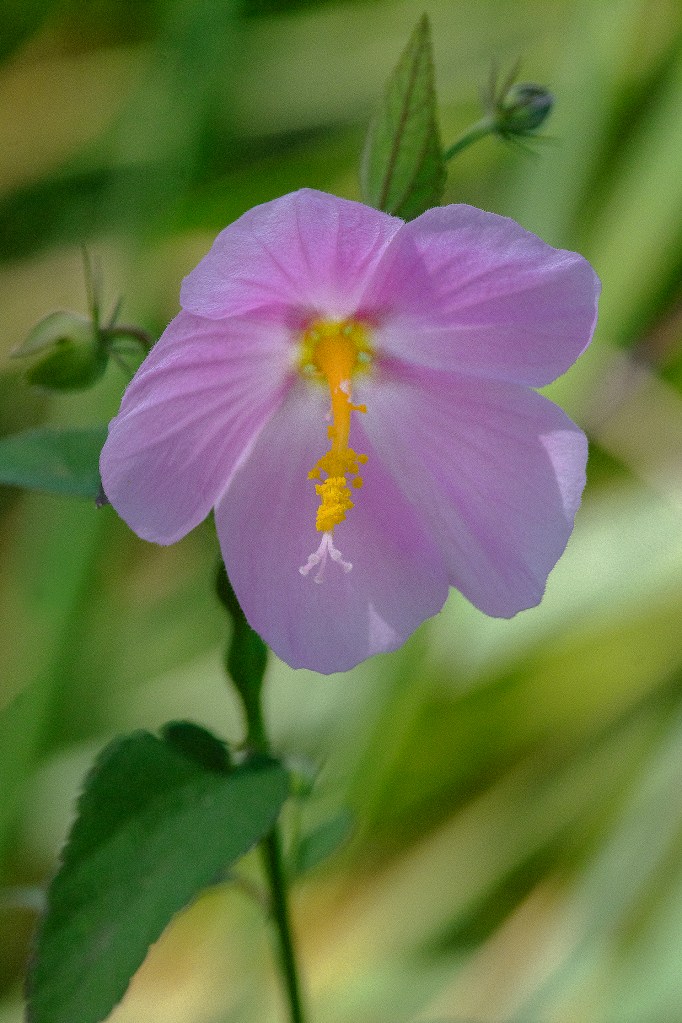
But I was even more captivated by the Saltmarsh Mallow (Kosteletzkya pentacarpos). Does it look to you a bit like a hibiscus? It’s not, at least not any more. Plants in the Kosteletzkya genus were separated from the Hibiscus genus in 1835. So they are related. Like most Hibiscus, Saltmarsh Mallow is an almost entirely edible plant. You can make tea from the flowers or use them to make an edible adornment to a salad. I’d rather photograph them!

August 19, 2023 – It was a great way to start a day! I and several other naturalists and photographers crouched on a beach of the Ouachita (“WAH shi tah”) River and gently placed turtle hatchlings on the sand. They had been hatched in a lab, but they knew immediately to scurry into the water and “do the twist,” a rapid scooching back and forth motion that effectively buries them in the sand where they were safe from predators–at least for the moment.
The lab is that of Dr. John Carr, Professor Emeritus of Biology at University of Louisiana Monroe. He has been researching and conserving turtles for years, not only the Smooth Softshell (Apalone mutica), but several other species that occur naturally in the lakes and rivers of northeast Louisiana. He and his graduate students remove the eggs from nests, thereby saving them from predation by foxes and raccoons. After incubating them until they hatch, which requires careful monitoring of temperature and humidity, the baby turtles are released back onto the same beach where the eggs were collected.
I am grateful to be one of the people Carr has invited into his lab to learn about the process and to help release the turtles back into the wild. It is one small way I can contribute to preserving biodiversity. And wouldn’t the world be a less interesting place without these odd-looking, snorkel-nosed turtles?!


Gorgeous flower, and the baby turtle is amazingly odd-looking and ever so cute!
LikeLiked by 1 person
Ms. Liz, The softshell turtles are indeed odd looking! They have that snorkel snout that enables them to breath while remaining completely submerged.
LikeLiked by 1 person
A real built-in snorkel! Wow.. who’d have thought?
LikeLiked by 1 person