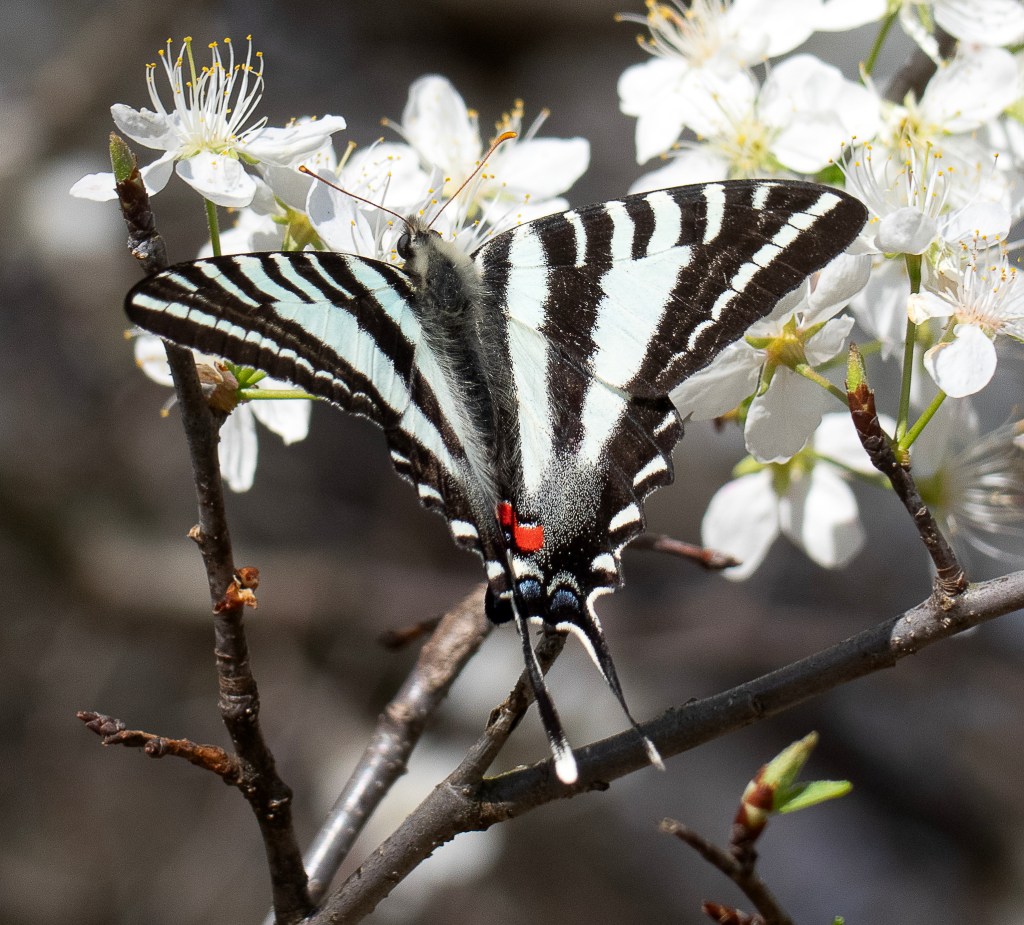
The Zebra Swallowtail is what is known in the butterfly world as a “specialist.” The adults nectar on a variety of white, open-throated blossoms, like the wild plum (Prunus species) in the photo above. But the caterpillars will eat only Pawpaw, thus the adults deposit eggs only on Pawpaw trees (Asimina triloba).
Poverty Point World Heritage Site has an abundance of Pawpaw trees. In fact, it has a trail named after the Pawpaw trees, and if you walk that trail the right time of year, you can go home with your pockets and your field pack–and even your bandana turned into a knapsack–full of ripe Pawpaws. I speak from experience!
For the past two years, I have been privileged to assist with an assessment of the natural resources at the Poverty Point Site. That means spending a couple of days there at different times of the year to catalog species of, well, everything: winged things (birds, butterflies, dragonflies, moths), crawly things (snakes and other reptiles and amphibians), green things (plants), and so forth.
Poverty Point has long been managed as an archeological site and it is well worth a visit to see the mounds and the museum full of artifacts of an ancient population of indigenous people. The current managers of the site are also interested in developing it as a natural area, and we are happy to advise them.
BTW, go in March to see this gorgeous little butterfly. But the pawpaws will not be ripe. That happens in late August, so you will invest some sweat equity in filling your pockets!
#YearInReview
 Edge & Essence
I really loved how you explained the Zebra Swallowtail as a “specialist.” That distinction between the adults nectaring on a variety of white, open-throated blossoms like the wild plum, while the caterpillars rely exclusively on Pawpaw (Asimina triloba), adds so much depth to the way we look at a landscape. It turns a simple walk into a kind of treasure hunt once you realize how specific that relationship is. The image of the blossoms works beautifully with your explanation, but what stayed with me most was the idea of walking the Pawpaw Trail at just the right time of year and literally carrying the experience home on your clothes. That detail makes it tactile and real, not just observational. I also appreciate how you tie this delicate ecological story to a place as historically significant as Poverty Point. It’s a great reminder that these sites hold layered narratives—human and natural—intertwined in ways we don’t always notice at first glance.
LikeLiked by 1 person
Berok, It is such a joy to read your comment! Thank you for seeing and responding so beautifully to my words and photo. I can see that you, too, are a close and careful observer of the natural world, and are as enthralled by the details of creature interaction, as I am. bjk
LikeLiked by 1 person